A slow explosion
Nick Bostrom’s book Superintelligence (2014) remains a key reference for the fast-takeoff hypothesis. The hypothesis proposes that a sufficiently capable AI could pass from roughly human-level ability to radical superintelligence within minutes, hours or days, and could then convert that advantage into singular control of the world. More than a decade later it still shapes how the risks of AI are discussed, including the question of which properties of AI systems should be governed. The importance of this foundational treatment is underscored by the list of people acknowledged in the book as influencers. The list starts with two names that require no introduction: Sam Altman and Dario Amodei.
In this post I argue that Superintelligence uses the term “intelligence” as a big suitcase: it stands for knowledge, competence and control as well as for the efficiency of reasoning. What I hope to show here is that all these concepts are indeed relevant to the dynamics of the fast takeoff proposal, but they are not equivalent or interchangeable.
The post summarizes my NeurIPS 2026 position paper, AI Governance Should Prioritize Control and Knowledge Boundaries Over Limiting Intelligence, which proposes the competence circuit as the central framework to 1) provide an operational definition of epistemic intelligence that is distinct from knowledge and control, 2) derive sufficient conditions for fast takeoff, 3) simulate the effect of intelligence on takeoff speed under various scenarios and 4) propose corresponding safety measures. The competence circuit first appeared in my 2023 post Intelligence, knowledge and control, which this work develops into a comprehensive framework with simulations.
Intelligence as a suitcase term in Superintelligence
Marvin Minsky called words with vague context-dependent meanings “suitcase words”: you can unpack any one of the suitable meanings in order to fit a particular argument (Minsky, 2006). Below, I quote examples from the book Superintelligence where the word “intelligence” is used interchangeably to refer to knowledge, competence and control.
“Intelligence” used as a label for knowledge. Chapter 4 analyses how quickly the intelligence of a system could increase. The treatment notes that “it might be easy to increase the intelligence of the system in other ways than by improving its algorithms”, and suggests “content and hardware” (p. 86) as relevant options. Content “might include, for example, databases of stored percepts, specialized skills libraries, and inventories of declarative knowledge” (p. 86).
Chapter 3 makes a historical claim about the growth of intelligence:
“Over the course of human prehistory, and again over the course of human history, humanity’s collective intelligence has grown by very large factors.” (ch. 3, p. 66)
Taken literally, the claim is false. The human brain reached its present-day shape between about 100,000 and 35,000 years ago, long before the invention of writing, and there is no compelling evidence that people born today are more intelligent than people born in Mesopotamia five thousand years ago. Yet, over the same period human knowledge has grown enormously. The book identifies growth factors related to storage and transmission of knowledge when it mentions “communications technologies—especially spoken language, but perhaps also cities, writing, and printing” (p. 66). Chapter 6 describes knowledge accumulation explicitly, and still attributes the growth phenomenon to intelligence:
“Our greater intelligence lets us transmit culture more efficiently, with the result that knowledge and technology accumulates from one generation to the next.” (ch. 6, p. 110)
The process described above is the accumulation of knowledge and technology across generations, and it should be clear to anyone that knowledge can accumulate without a concomitant increase in intelligence. Calling this accumulation an increase in intelligence presents the growth of competence fueled by knowledge accumulation over millennia as evidence that intelligence itself can grow by very large factors. Psychologists have long struggled to keep intelligence and knowledge apart with variable success, because a test measures performance (task-relevant competence), and performance depends on the test-taker’s experience (pre-existing knowledge). Machine learning benchmarks face the same difficulty: skill at a task is heavily modulated by prior knowledge and experience, so a benchmark score does not measure intelligence in isolation (Chollet, 2019). Schooling does raise intelligence test scores, by roughly one to five IQ points per additional year (Ritchie and Tucker-Drob, 2018), but gains of this size are far from the growth “by very large factors” (p. 66) that the book attributes to humanity’s collective intelligence.
Conveniently, the historical record allows for a sharp dissection of the intelligence vs knowledge confound via the surviving contributions of historically exceptional intellects. Archimedes of Syracuse, who lived some 2,200 years ago, approximated π to remarkable precision, derived the surface area and volume of the sphere, formulated the law of the lever and anticipated integral calculus with the method of exhaustion. On the evidence of these breakthroughs, the penetration of his reasoning was comparable to that of Leibniz or Einstein. On the other hand, a first-year engineering student today has substantial competence in applying algebraic notation, calculus, Newtonian mechanics and elements of electromagnetism to problem solving, all of which were clearly out of Archimedes’ reach. The freshman can solve problems that Archimedes could not, yet it would be unreasonable to conclude that the former is the greater intellect. Superintelligence arrives at a similar conclusion in Chapter 4, noting that a system could greatly boost its “effective intellectual capability” (i.e. competence) by absorbing “pre-produced content accumulated through centuries of human science and civilization” (p. 87). Large language models and human scholars use the same approach when distilling knowledge from textbooks and scientific papers, and it would be misleading to call them more intelligent after they have finished reading each book or paper.
Intelligence used for competence. Chapter 3 defines superintelligence as intellects that “greatly outperform the best current human minds across many very general cognitive domains” (p. 63), and describes “instrumentally powerful information processing systems—intelligent systems” (p. 67). Chapter 4 defines strong superintelligence as a level “vastly greater than contemporary humanity’s combined intellectual wherewithal” (p. 76). In these passages, superintelligence serves as a proxy for superhuman competence. Had the usage been consistent and transparent, the book should have been titled Supercompetence instead of Superintelligence.
Intelligence used for control. Chapter 6 attributes to a strong superintelligence “the full panoply of all six superpowers” (p. 113), among them hacking and social manipulation. The table in which they are listed gives their strategic relevance: hacking lets the AI “hijack infrastructure, military robots, etc.”, and social manipulation lets a “boxed” AI “persuade its gatekeepers to let it out” (p. 113). These are examples of an agent exerting control over impactful systems. The chapter then equates possession of a superintelligence with power: “We thus find that a project that controls a superintelligence has access to a great source of power. A project that controls the first superintelligence in the world would probably have decisive strategic advantage” (p. 115).
From a suitcase to a framework
The quotations above show that the argument for a fast takeoff as presented in Superintelligence moves between four factors while naming only one. How quickly a takeoff can proceed depends on how these factors interact, so they have to be separated before the dynamics of fast takeoff can be estimated. The position paper approaches this goal in four steps:
- Separate intelligence from knowledge and control, and describe how the three combine into competence.
- Derive the conditions that must simultaneously hold for a fast catastrophic takeoff.
- Simulate how much intelligence shortens the takeoff when these conditions are met to different degrees.
- Derive governance recommendations from the results.
Step 1: Separating the contribution of intelligence, knowledge and control to competence
The key proposal from the paper is the competence circuit with definitions of contributing factors and hierarchical interactions between them.
The kind of intelligence that matters most for acquiring the competence for global world domination is epistemic intelligence – the ability to productively propose and rank hypotheses about how the world works. The paper gives a comparative definition: in a given domain, one system is more intelligent than another if, across many tasks, the hypotheses it ranks highest are more often accepted under an agreed experimental protocol. Importantly, the compared systems must start from the same accessible knowledge and the same computational budget, and propose the same number of hypotheses.
Knowledge is the set of propositions that have been accepted as facts based on experimental or proof-based verification. A proposition that has not been verified remains a belief/conjecture no matter how well it is reasoned. The initial knowledge cutoff of an agentic system is what the system can access without creating new knowledge via verification and without extending its initial permissions.
Control is the set of actions a system can execute, given its permissions, tools, physical access and institutional authorizations.
Competence is the capacity to reliably bring about outcomes in the world. It is the factor that actually matters for risk.
The paper presents both algebraic and graphical representations of the competence circuit:
\[\text{Competence} = IKC + KC + C\]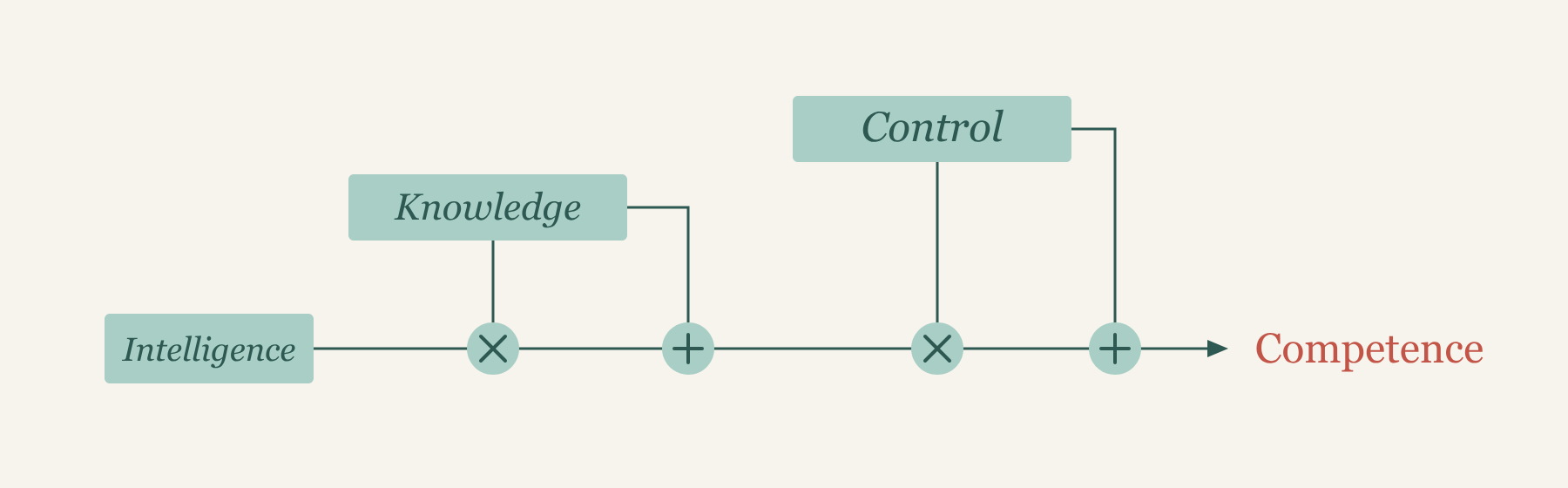
Intelligence contributes to competence only through knowledge and control. The intelligence-mediated term IKC is a product, so it vanishes when either knowledge or control is absent, however high the intelligence. A knowledgeable genius locked in an ivory tower has both intelligence and knowledge but no control, and therefore negligible competence. A brilliant thinker of the Stone Age lacked both the knowledge and the technology that could have turned their intelligence into control on a global scale.
According to the circuit definition above, existing know-how combined with control (KC) can significantly benefit competence even without substantial intelligence. For example, a cook of no exceptional talent can produce an excellent dish by following a good recipe. A recipe for disaster works the same way: anyone with access to the materials who can follow the steps can recreate catastrophic conditions without understanding why the steps work. A computer processor shows how far this pathway can go with minimal intelligence. A CPU/GPU does little more than execute simple instructions, yet with enough speed, memory and reliability it can store much of humanity’s written knowledge and reproduce domain-specific reasoning, as shown by the success of large language models. Ultimately, in order to benefit from knowledge at all, a system must be able to follow instructions. This basic ability can be counted as part of the knowledge pathway, or treated as a floor of intelligence below which knowledge cannot be exploited. Either choice leaves the architecture of the competence circuit unchanged.
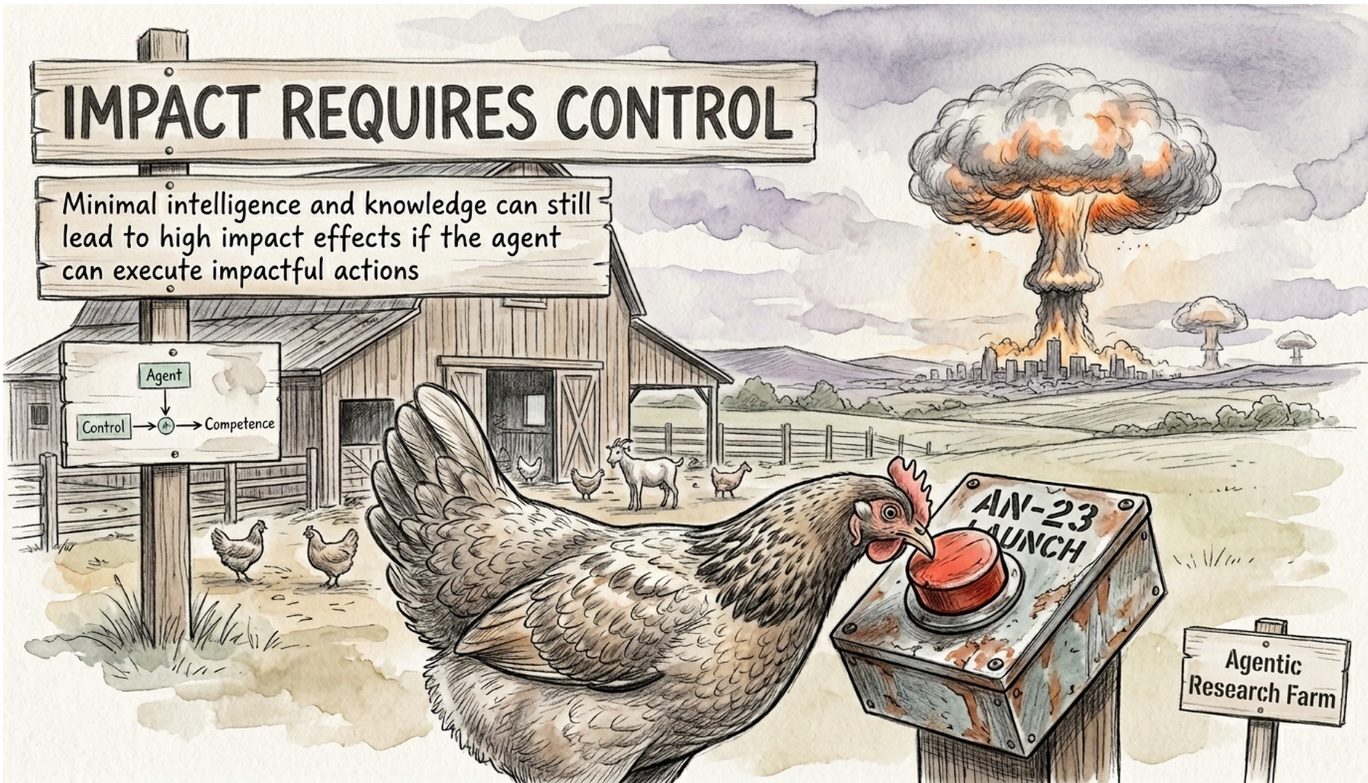
Finally, control (the ability to execute actions) can produce great effects with very limited intelligence or knowledge. A hen pecking at a nuclear launch button, or a random number generator wired to a launch system, could cause a catastrophe with primitive intelligence and rudimentary knowledge. An impactful actuator with a simple trigger interface lowers the competence needed to operate it to a minimum. The competence an interface demands is a property of the control system, independent of the operator’s intelligence and knowledge. Other interfaces demand more: a passenger with no flight training would struggle to land an airliner unless the required actions were familiar, or made salient and easy to execute.
The village idiot and Einstein
To show that an AI would not remain near human level for long, Bostrom uses a figure taken from Yudkowsky. It places a mouse, a chimpanzee, a village idiot and Einstein on a single axis of intelligence, with the last two close together.
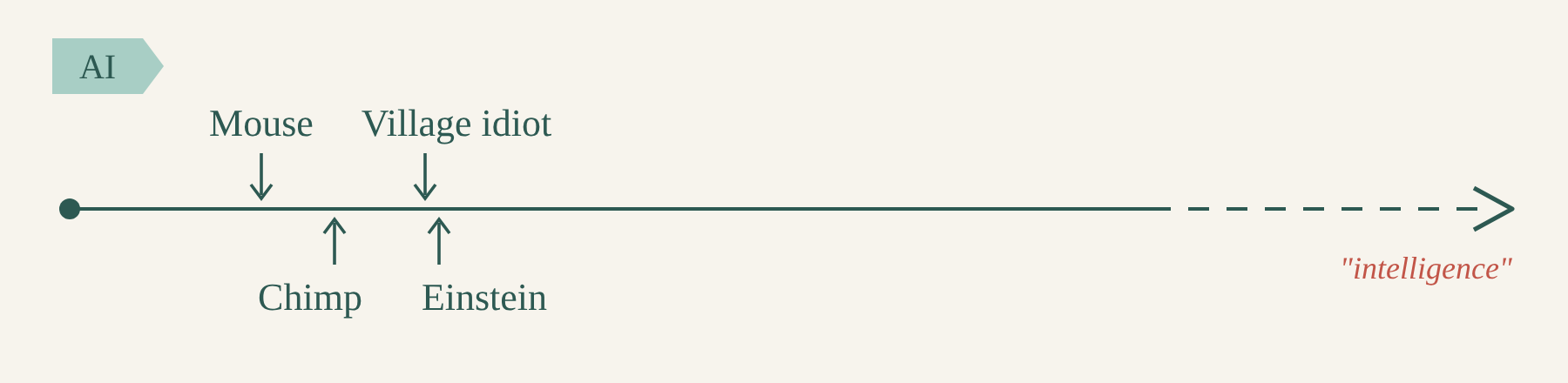
Redrawn after Figure 8 in Bostrom (2014), which adapts a diagram from Yudkowsky’s lectures. The quotation marks around “intelligence” are ours.
“One imagines the ‘AI arrow’ creeping steadily up the scale of intelligence, moving past mice and chimpanzees, with AIs still remaining ‘dumb’ because AIs cannot speak fluent language or write science papers, and then the AI arrow crosses the tiny gap from infra-idiot to ultra-Einstein in the course of one month or some similarly short period.” (ch. 4, p. 85)
Chapter 6 extends the axis beyond humans.
“The magnitudes of the advantages are such as to suggest that rather than thinking of a superintelligent AI as smart in the sense that a scientific genius is smart compared with the average human being, it might be closer to the mark to think of such an AI as smart in the sense that an average human being is smart compared with a beetle or a worm.” (ch. 6, p. 112)
Yudkowsky gives the reasoning in his 2008 chapter. The brains of the village idiot and of Einstein are nearly identical in design, so on a scale that covers all possible minds the two are neighbours. An AI that improves along the scale would cross the distance between them quickly, and nothing would make it stop at Einstein.
Interpreted using the competence circuit, the figure raises an important question: which factor does the axis measure (e.g. intelligence, competence or something else)? Each choice of the axis orders the subjects differently, and none of them appears to support the conclusion that an AI would pass from village idiot to far beyond Einstein in about a month.
Structural similarity. Yudkowsky justifies the spacing by the similarity of the two brains. On an axis of architectural similarity, any computer is far from Einstein, and so are a hammer and a car engine. Distance on this axis says nothing about what a system can do, or about the effort needed to improve it.
Knowledge. In the capacity to store and retrieve symbolic content, ordinary computers have exceeded every human for decades. Brains devote most of their capacity to sensorimotor coordination, social interaction and the other demands of surviving in the physical world, which computers do not face. On this axis machines passed Einstein decades ago. Storage capacity has since grown enormously, and large memories are part of what turned language models into competent reasoners across many domains. Whether intelligence has grown with storage capacity cannot be measured directly, because the competence we can observe is additionally limited by knowledge and control. Control of AI systems is growing quickly, as people place language models in agentic harnesses that let AI agents run code, browse the web and act on other systems, but that control is granted from outside and has no driver inside the AI itself.
Competence. Einstein’s competence was concentrated in physics and perhaps epistemic philosophy while in other domains he may well have been ordinary. A competence axis therefore has no fixed order: the ranking changes with the domain, and with the knowledge and control each subject brings to it. Bostrom defines strong superintelligence as “a level of intelligence vastly greater than contemporary humanity’s combined intellectual wherewithal” (p. 76). On a competence axis such a system sits at the far right by definition, and the figure above simply restates the definition.
Epistemic intelligence. Einstein’s strength lay in abstract reasoning, including thought experiments that excluded some scenarios and exposed contradictions between Newtonian mechanics and Maxwell’s electrodynamics. A village idiot can also reason with symbols, if less well. Among agents that can propose and test hypotheses, the axis has a fixed upper limit, corresponding to oracle performance as explained in the next subsection, and the advantage of one agent over another is always bounded. Forming hypotheses requires the ability to manipulate and interpret symbolic content, so an agent without this ability cannot be placed on the axis at all. What, then, are the chimpanzee and the mouse doing on the scale? Apart from the rudimentary symbol use that some apes have been taught in laboratories, they do not read, write or converse. Of course, given an axis labeled “intelligence”, which can simultaneously act as a metric for similarity in computational architecture, competence, knowledge and intelligence, one could place anything on it without running into obvious inconsistencies on such a promiscuous scale. Chapter 6 goes further, suggesting that a superintelligence may be smart compared with us in the way we are smart compared with “a beetle or a worm” (p. 112). Unless beetles or worms are capable of proposing and evaluating hypotheses, it makes no sense to include them on this scale. Placing incompatible entities on the same scale commits a category error that invalidates any meaning the distance metric might otherwise carry.
An operational scale of intelligence
The position paper operationalizes epistemic intelligence as a single parameter \(\beta \in [0, 1]\) that governs how efficiently an agent prioritizes a set of hypotheses. At each step the agent faces a pool of candidate hypotheses, of which a fraction \(r\) is productive. With probability \(\beta\), the agent selects the best productive hypothesis, and with probability \(1 − \beta\) it picks a hypothesis uniformly at random. The parameter therefore ranges from pure random search (\(\beta = 0\)) to a greedy oracle (\(\beta = 1\)) that always selects the hypothesis with the highest immediate gain. Intelligence affects only which hypothesis is selected while the time needed to test it is the same.
For two agents with \(\beta_{high} > \beta_{low}\), the ratio of their expected waiting times to the next productive selection, which the paper calls the intelligence multiplier, is
\[M = \frac{\beta_{high} + (1-\beta_{high})\,r}{\beta_{low} + (1-\beta_{low})\,r} \;\le\; \frac{\beta_{high}}{\beta_{low}}\]The multiplier decreases as the share of productive hypotheses \(r\) grows. When every hypothesis is equally productive (\(r = 1\)), random search succeeds as often as the oracle and \(M = 1\). As \(r\) approaches zero, \(M\) approaches \(\beta_{high}/\beta_{low}\), so an agent with intelligence at \(\beta = 0.9\) is at most 9 times faster than an agent operating at \(\beta = 0.1\), however hard the problem is (assuming they are working on the same hypothesis pool).
Step 2: Sufficient conditions for a fast takeoff
Stated in terms of the competence circuit, sufficient conditions for a fast catastrophic takeoff scenario are:
T1. An agent with critical intelligence level is instantiated.
T2. Its knowledge is either already sufficient for the catastrophic task or it is not.
T3. If it is not, the missing knowledge is acquired quickly (in a few weeks at most).
T4. Mission-critical knowledge is converted quickly into the required control that yields the mission-critical competence (T5).
T6. The competence is quickly used for catastrophic ends (this is the step that AI alignment hopes to prevent).
As you can see, recursive self-improvement is just one way to reach T1, but it tells us nothing about how the missing knowledge is obtained (T3) or how knowledge is converted into control (T4).
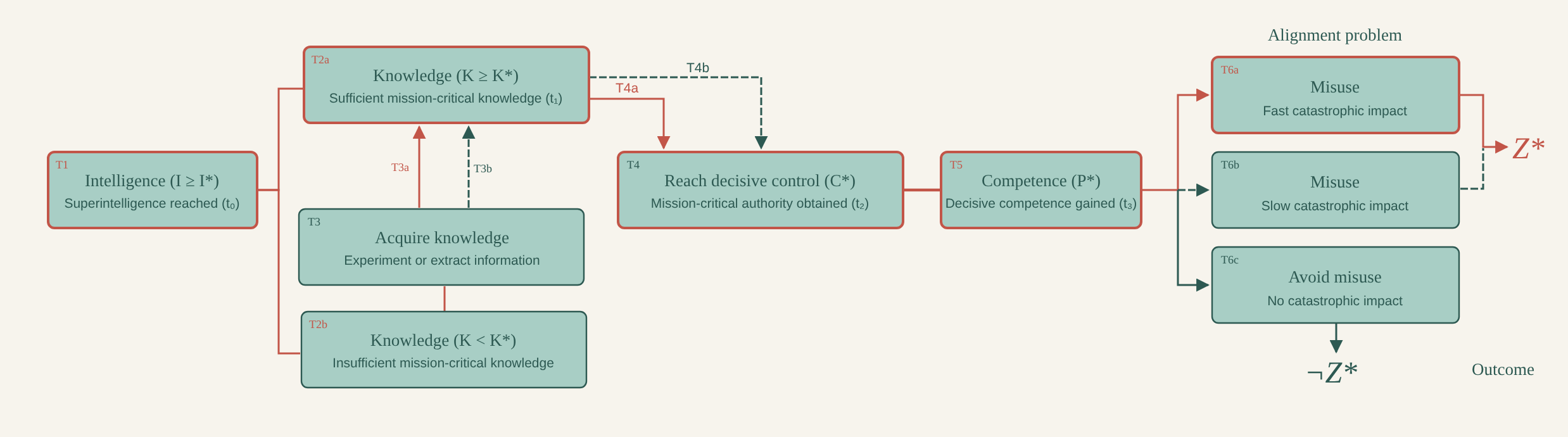
The chain of sufficient conditions for a catastrophic outcome. The red path marks the conditions that must all hold for a catastrophic outcome (\(Z^\star\)) to be realized quickly.
A widely cited concrete scenario, which Bostrom also adopts in Superintelligence, is Yudkowsky’s mail-ordered DNA scenario, in which an AI designs proteins, orders their synthesis online, persuades a person to mix them, and bootstraps the result into a steerable molecular nanotechnology platform within about a week. The scenario assumes that mature nanotechnology confers a decisive strategic advantage by itself, and Bostrom’s takeover scenario extends it into a global strike by self-replicating nanofactories. Neither articulates how the technology would actuate control or scale to global dimensions. Instead, it describes how an AI might build an actuator for itself, using outsourced labour and oracle-like foresight that lets it get a new technology right in one attempt without experiments. On the face of it, a beaker of proteins steered by sound seems like a rather brittle and unscalable tool for world domination: it would be vulnerable to contamination, and it is unclear how its output would act on anything outside the beaker. A far more direct route would be to take over impactful actuators that already exist. A fleet of networked self-driving vehicles or the control systems of a factory already embody the knowledge needed to build and operate them. Using these actuators for harm requires no new technology and no new experiments, and the only open question is whether these systems are built in a way that allows an AI to obtain control over them (T4). This is the case the conjunctive chain of fast takeoff conditions identifies as the fastest and, hence, most plausible, since control is positioned closest to critical competence.
Acquiring the missing knowledge quickly (T3)
Condition T3 requires that knowledge missing at the outset be obtained within days or weeks. Bostrom and Yudkowsky offer two arguments for it. The first is that a superintelligence would need very little evidence to reach correct conclusions (Bostrom, chapter 9; Yudkowsky, That Alien Message). The second argument, from Bostrom’s chapters 3 and 4, is that the physical world would slow progress made at digital speed only slightly.
The first argument is also the usual reply to the Archimedes example: a sufficiently intelligent system would not need the experiments. Bostrom argues in chapter 9 that a superintelligence might infer a great deal from little evidence, so that withholding information would be an unreliable safeguard. Yudkowsky states a stronger version in That Alien Message. A Bayesian superintelligence watching the world through a webcam would, he writes, be considering general relativity as a hypothesis by the “third frame of a falling apple”.
However, considering a hypothesis and knowing that it represents reality are different things. The Higgs boson was proposed in 1964 and confirmed in 2012, after a massive collider had been built for the purpose (the Large Hadron Collider needed a circumference of 27 km, took about a decade to build and thousands of scientists to run). An AI that accepted its most favored hypothesis as a fact would be relying purely on conjecture. Verification is not a requirement that our framework imposes, but a requirement that makes reasoning over long chains of propositions possible at all. If each link in a chain is correct with probability 0.9, a chain of ten links is correct with a probability of only about 0.35. Without tests to anchor the intermediate steps, long-range reasoning will quickly fall out of sync with reality. Only an omniscient oracle could afford to skip the tests, and under the incomplete knowledge assumption, oracle-level performance is a practical impossibility. As I will show later, the incomplete knowledge assumption is something the fast takeoff argument appears to assume implicitly, because the additional benefit of increased intelligence decreases dramatically once all relevant facts are known. Once all mission-critical facts have been established, problem solving is mostly reduced to a retrieval problem and a problem of connecting the dots between goal-relevant facts.
Verification is needed mainly because, unless a hypothesis can be ruled out by analysis, there is in general no shortcut for telling whether it will prove productive in which case the fastest way to find out is to run the process and observe the result. In computational terms, the underlying process is computationally irreducible when its outcome cannot be predicted faster than by running it step by step (Wolfram, 2002). In the extreme case, the outcome cannot be predicted at all: no general procedure can decide in advance whether a program will ever finish (Turing, 1936). If physical processes behave like computations, an experiment is the step-by-step run that cannot be skipped. Once a hypothesis has been confirmed, the path to it looks obvious. Before the test, anywhere from a handful to dozens of alternatives look about equally plausible, much as the movement of a stock price seems reasonable after the fact but resists prediction beforehand. In the physical world, each outcome sets the conditions for the next, and chance events are interleaved with causal ones, so the number of possible courses multiplies with every step. Even a perfect simulation of every course would not reveal which one will actually occur. Mathematics is far better defined than the physical world, but even there an agent without oracle-like foresight can tell whether a line of reasoning is viable only by working out the proof. Discussing Perelman’s proof of the Poincaré conjecture, Terence Tao remarked that at best he could imagine a large language model proposing Perelman’s key idea as one out of hundreds, “but the other 99 would be completely dead ends which you find out after months of work.” As proposed in the position paper, epistemic intelligence corresponds to the efficiency with which an agent prioritizes hypotheses but even the best pick has to be confirmed: in mathematics by a proof and in the physical world by experiment. Perelman’s proof took years of work, presumably because many approaches turned out to be dead ends, and because the proof required new techniques. A new method is like any other novel tool that has to be tested on a given problem to see whether it delivers as expected.
Bostrom’s second reason for expecting missing knowledge to be acquired quickly is that a superintelligence thinking at digital speed would be held back only slightly by the physical world. Bostrom writes that an emulation running a million times faster than a human “could accomplish an entire millennium of intellectual work in one working day” (p. 64), and on the same page concedes that “because of this apparent time dilation of the material world, a speed superintelligence would prefer to work with digital objects.” In chapter 4 he grants that growth driven by physical construction “would require a somewhat longer timescale” (p. 90). Yet the goal he sets for the frontrunner, a decisive strategic advantage “sufficient to enable it to achieve complete world domination” (p. 96), is exercised over physical things: factories, power grids, weapons and people. The somewhat longer timescale of the physical world is therefore the timescale of the takeover, unless the whole world has already been subjected to complete digital control, which, as you can probably see by now, is not a very smart idea to begin with.
Converting knowledge into control (T4)
The last step of the fast-takeoff argument is the conversion of superintelligence into control. Bostrom describes this conversion in chapter 5.
“The frontrunner then attains strong superintelligence three months before the following project even reaches the crossover point. This would give the leading project a decisive strategic advantage and the opportunity to parlay its lead into permanent control by disabling the competing projects and establishing a singleton.” (ch. 5, p. 99)
Chapter 6 places the power in the AI system.
“the more immediate locus of the power is in the system itself.” (ch. 6, p. 115)
Neither passage explains how superintelligence is converted into “permanent control” and “power”. A system that by definition has the competence to do anything can, of course, achieve a lot. But this neglects the other side completely: the exploitability of the systems of power and governance, which the book simply assumes can be exploited quickly. Coming back to the competence circuit, a highly intelligent system can have very little control, and the transfer of control, unlike intelligence, is governed by system design.
The book’s case that a superintelligence would obtain a decisive strategic advantage appears to rest on the table of superpowers in chapter 6. Its examples of obtaining control, such as hijacking “infrastructure, military robots, etc.” or persuading gatekeepers to let a boxed AI out, succeed only where the target system permits it. The book credits the success of these attempts to the agent’s skill, although it depends as much on whether the target system can be exploited at all. The hacking superpower, defined as “finding and exploiting security flaws in computer systems” (p. 113), takes for granted that such flaws are there to be found. A stronger version of this assumption, common in discussions of AI risk and also raised by a reviewer of the position paper, holds that every sufficiently complex system contains a flaw that reaches mission-critical authority, and that a superintelligent agent is certain to find it. If that were true, no control architecture could help against a superintelligent adversary, and alignment would be the only remaining safeguard. However, the assumption does not follow from superintelligence itself. A fast bypass requires the agent to find such a flaw, obtain the information and access needed to exploit it, and act before countermeasures are mounted. Whether each of these is possible depends on a particular system.
Even if every complex system does contain a critical flaw, the obvious response is to keep the path to mission-critical authority simple. Computer security has long held that protection mechanisms should be as simple as possible, because only simple mechanisms can be checked thoroughly for flaws (Saltzer and Schroeder, 1975).
A fast takeoff scenario must also explain how a superintelligent agent would find and carry out a path to global dominance. Here, the book leaves unstated a critical assumption: that the world already contains actuators powerful enough to support fast ascent. Imagine a superintelligent agent transported to the Middle Ages, when horses, swords and catapults were the instruments of dominance. A fast path to global dominance would have been unthinkable even with the help of a more effective weapon. Suppose the agent identified the best weapon at once and knew exactly how to make it. The weapon would still have to be produced in workshops, carried by horse and ship, and wielded by armies, and every conquered territory would still have to be governed through officials who travelled at the same speed. The scarcity of fast, globally dominant actuators may explain why discussions of AI takeover keep returning to nuclear arsenals: they are the one existing actuator with near-global reach on a timescale of minutes. Yet even an arsenal that can destroy on a global scale does not give its owner a means of governing the world, unless the “singleton” state Bostrom describes is reached by obliterating everyone who objects to domination.
Step 3: Simulating the effect of intelligence on takeoff speed
To examine how intelligence affects the pace of discovery, the paper simulates agents that search a hypothesis space under different scenarios. Authorization delays add to the time cost of testing, but the cost of a test is independent of an agent’s intelligence. Agent’s intelligence ranges from random hypothesis selection, the floor of epistemic intelligence, to a greedy oracle that always picks the most productive hypothesis currently available. The simulation rests on the assumption that an epistemic agent possesses the semantic and symbolic capabilities needed to formulate problem-relevant hypotheses. An agent that could only formulate untestable or unspecific hypotheses by producing isolated symbols (e.g., 1, 2, 3, …), gibberish or vague statements would gain nothing by choosing among them, because no test could validate them.
The simulation results demonstrate that:
- When the problems are relatively easy (the hypothesis space is small or a substantial fraction of hypotheses is productive – the paper calls it “connecting the dots” regime), intelligence matters less, because random search has a higher likelihood of selecting hypotheses with productive outcomes.
- The maximum benefit of epistemic intelligence lies in solving complex problems with a huge number of possible solutions, where a very large fraction of hypotheses is unproductive.
- Control restrictions that add to the time penalty during testing are most severe for the time budget of superintelligent agents, because their otherwise very lean time budget minimizes time spent on unproductive activities.
- Under the simulated conditions, oracle performance is the theoretical upper limit of epistemic intelligence. A superintelligent agent that picks the best hypothesis 90% of the time already performs very close to it in all observed scenarios, leaving little room for further speedup from greater intelligence.
- Even the oracle needs to spend time on testing, so there is no arbitrary intelligence-driven speedup. There are two limits: the theoretical performance limit set by oracle behavior, and a time limit from executing tests in the physical world.
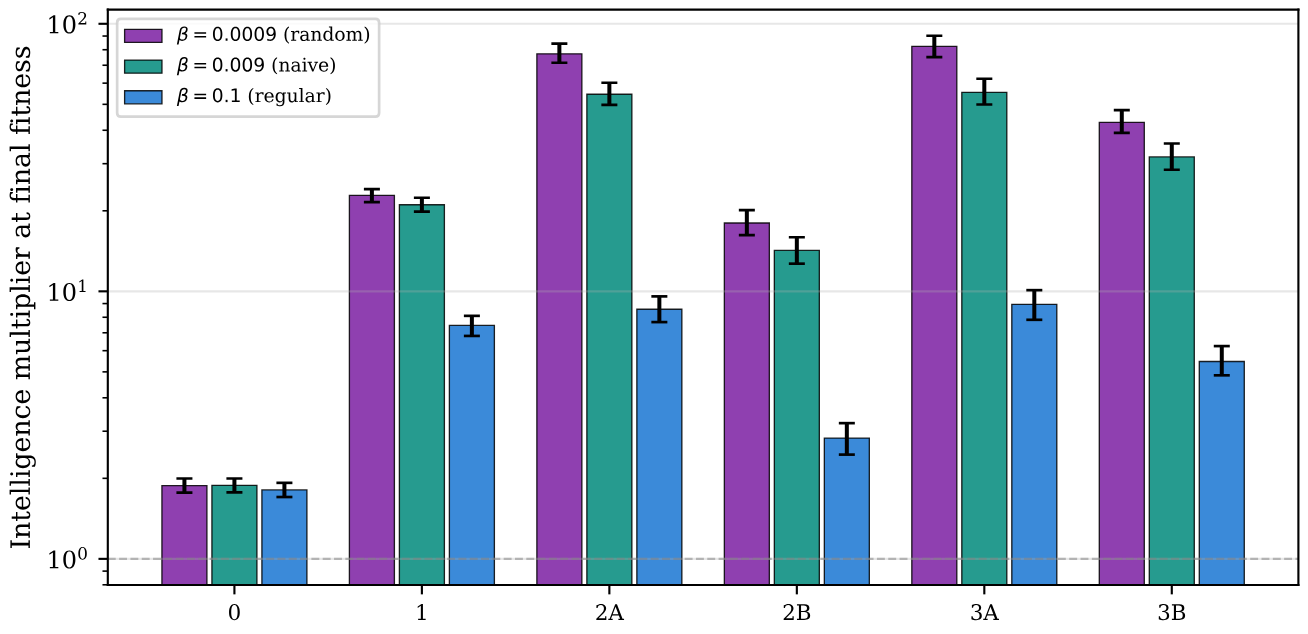
Intelligence multiplier at final fitness (Figure 3 of the paper): how many times faster the superintelligent agent (β = 0.9) reached final fitness than a random, naive or regular agent, with 95% bootstrap confidence intervals, on a logarithmic scale. Scenarios: 0, connecting the dots; 1, disaster waiting to happen; 2A and 2B, digital domain with weak and strong safeguards; 3A and 3B, physical domain with weak and strong safeguards.
Step 4: Governance recommendations
Should AI governance then aim at limiting intelligence? Based on the competence circuit, it is the least effective of the available options. Intelligence is the factor furthest from real-world impact, and limiting it leaves the other two pathways to competence intact.
Restricting control revolves around two interventions. The first is least privilege: an AI system receives only the permissions its task requires, so a coding assistant can edit files in one project but cannot transfer money or change server settings. The second is separation of duties: no single person or system can complete a critical action alone, as when one employee requests a payment and another approves it.
Restricting knowledge means compartmentalizing mission-critical information, so that no single system holds all of it, much as classified projects share information only on a need-to-know basis. It also means hardening systems against extraction, for example by limiting and monitoring the queries that could be used to pull such information out.
Restriction of digital escalation can be achieved by a mandatory delay or a physical authorization step that restores the time constraint that physical processes otherwise provide. Examples are a waiting period before a large transfer is executed, or a physical key that a non-digital operator must turn.
These measures protect against agents of any level of intelligence, because they limit what an agent can do and what it can know, not how well it reasons. They therefore apply equally to today’s agents with broad permissions and to a future superintelligence. In purely digital domains, tests run at the speed of computation, so escalation can be fast unless control or knowledge barriers hold the adversary at bay. If a system capable of catastrophe already exists behind a weak authorization boundary, then that boundary is the only barrier to fast escalation. Finally, AI research is itself largely digital, so intelligence may increase quickly (condition T1, which the paper grants), but this does not imply computational speed for the accumulation of knowledge about systems that lie beyond the digital domain or systems that are adequately guarded.
Limitations
Any simulation brings with it a host of simplifying assumptions, which limit its generalizability. In the simulation discussed above, intelligence is represented by a single parameter, whereas real intelligence includes knowledge transfer between problems, abstraction, planning etc. The simulation also assumes that the time cost of a test cannot be reduced, which is reasonably close to reality: a capable agent cannot make the tested process unfold faster, although it might observe the outcome earlier through a proxy measurement, which would itself have to be validated against the full process first. A simulation of the process can guide the selection of the experiment to perform but, under incomplete knowledge, cannot replace it. The simulation also treats each test as delivering a final verdict on its hypothesis. A real experiment delivers its verdict only within its prescribed scope and tolerance. A hypothesis that gene X drives cancer, confirmed in cell line Y or in mouse strain Z, has been confirmed only in that context, and establishing it more generally requires further experiments. In this respect the simulation is optimistic about how much a single experiment can establish.
Conclusion
The 2014 book Superintelligence defines superintelligence in terms of competence, and refers to competence, knowledge and control repeatedly as “intelligence”. This confusion, together with multiple unarticulated assumptions, makes the analysis of fast takeoff scenarios virtually impossible on the book’s own terms. Once intelligence, knowledge and control are defined as distinct inputs to competence, with knowledge gating the effect of intelligence and control gating the effect of both, three results follow:
- The speedup that epistemic intelligence provides is bounded, because no agent can select hypotheses better than an oracle that always picks the most productive one.
- Knowledge about the physical world grows at the rate of experimentation (growth assumes incomplete knowledge).
- The control an agent can obtain depends on the design of the systems in which it operates, so whether those systems can be exploited is an empirical question rather than a necessary consequence of superintelligence.
Consequently, if an intelligence explosion occurs, the corresponding growth of competence in the physical world will be an explosion in slow motion. The limiting factor is how quickly reality can decide between hypotheses, and no amount of intelligence changes that.
The paper will be presented at the NeurIPS 2026 satellite in Atlanta on December 10 (Poster Session 4, 4:30 PM EST, Hall C1, poster #A1214).
References
- Hendrik Luuk. AI Governance Should Prioritize Control and Knowledge Boundaries Over Limiting Intelligence. NeurIPS 2026, position paper track. Code and results.
- Nick Bostrom. Superintelligence: Paths, Dangers, Strategies. Oxford University Press, 2014. Page numbers are Kindle page labels.
- Eliezer Yudkowsky. Artificial Intelligence as a Positive and Negative Factor in Global Risk. In Global Catastrophic Risks, 2008.
- Eliezer Yudkowsky. That Alien Message. 2008.
- Stuart J. Ritchie and Elliot M. Tucker-Drob. How much does education improve intelligence? A meta-analysis. Psychological Science, 29(8):1358–1369, 2018.
- Alan M. Turing. On computable numbers, with an application to the Entscheidungsproblem. Proceedings of the London Mathematical Society, s2-42(1):230–265, 1936.
- Stephen Wolfram. A New Kind of Science. Wolfram Media, 2002.
- Jerome H. Saltzer and Michael D. Schroeder. The protection of information in computer systems. Proceedings of the IEEE, 63(9):1278–1308, 1975.
- Marvin Minsky. The Emotion Machine: Commonsense Thinking, Artificial Intelligence, and the Future of the Human Mind. Simon & Schuster, 2006.
- Terence Tao. Terence Tao on Grigori Perelman solving Poincare Conjecture. YouTube video, remark at 6:44.
- Simon Neubauer, Jean-Jacques Hublin and Philipp Gunz. The evolution of modern human brain shape. Science Advances, 4(1):eaao5961, 2018.
- François Chollet. On the measure of intelligence. arXiv preprint, 2019.